Introducing the problem: Vacancy Decontrol as the key driver that financialized landlords exploit to push tenants out and skyrocket rents.
Rising rents in the Greater Toronto Area (GTA) are a central driver of tenant displacement, particularly in neighborhoods with large stocks of older, purpose-built rental housing. Over the past decade, rents have increased significantly faster than household incomes, making it increasingly difficult for low and moderate-income households to remain in their communities. This trend is closely tied to the financialization of housing, where investors acquire aging rent controlled buildings and generate profits by raising rents, often through tenant turnover. Through this process, housing is increasingly treated as a financial asset rather than a basic human need.
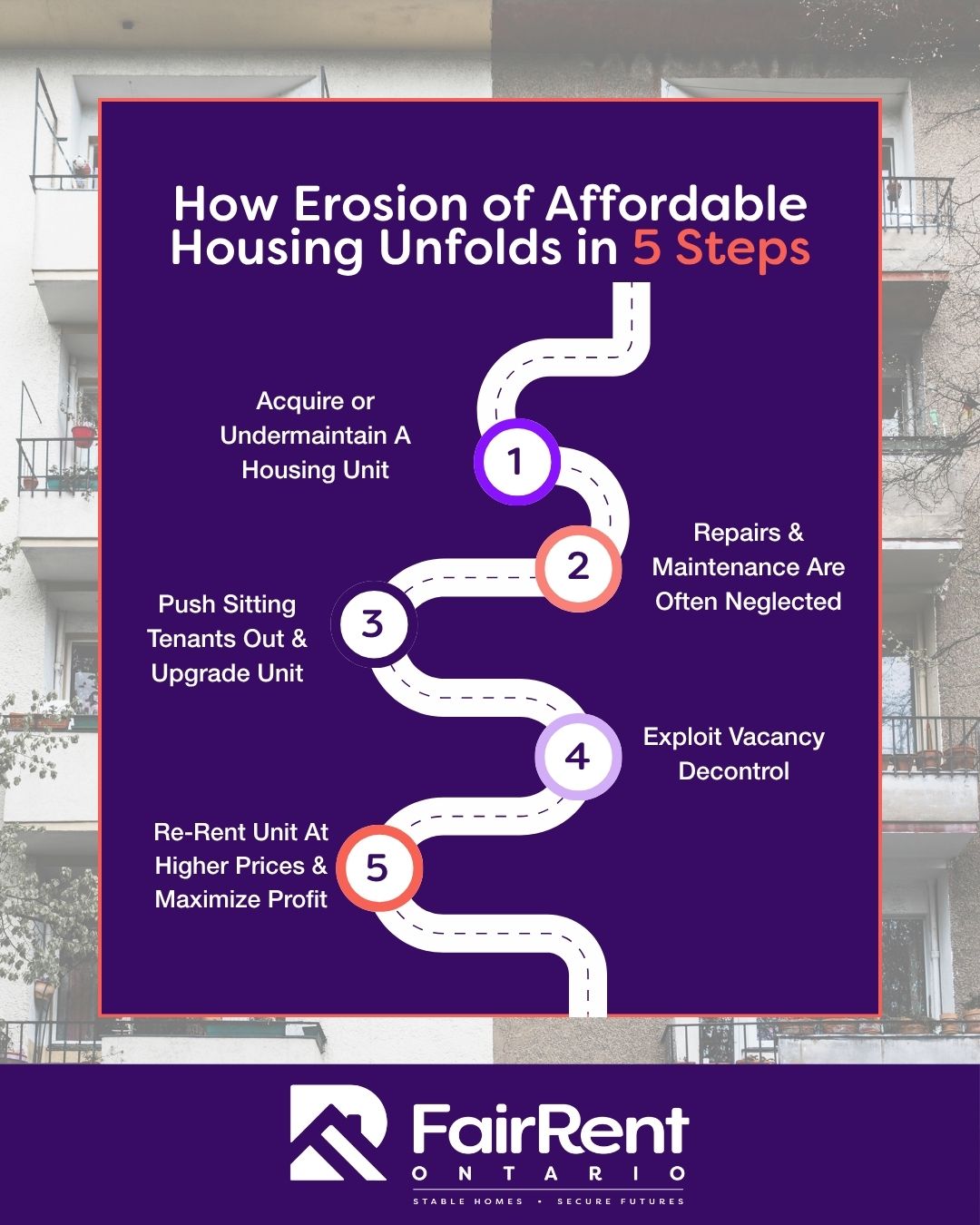
One of the most significant policy mechanisms enabling this dynamic is vacancy decontrol; an exploitative mechanism that permits landlords to raise rent prices for new tenants by as much as they want once the unit is vacated. This creates a strong financial incentive for landlords to remove sitting tenants, particularly long-term tenants paying below-market rates, to re-rent the vacant units to new tenants at much higher prices. Hence, vacancy decontrol disproportionately impacts lower-income tenants, who already face limited housing options and greater difficulty securing affordable, suitable housing.
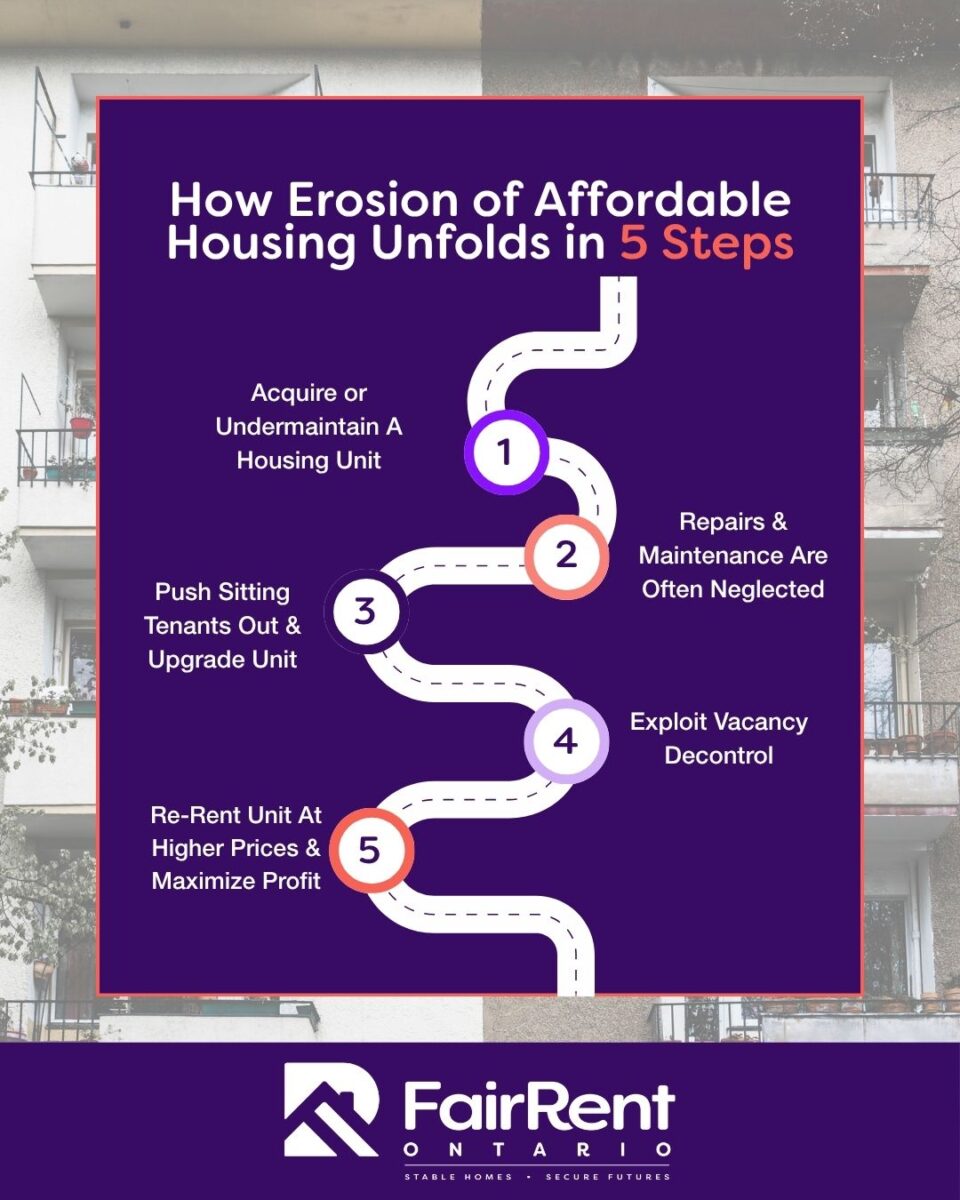
Financialized landlords make decisions based on how quickly and how much profit they can generate, with little regard for the long-term stability or affordability needs of tenants. As a result, financialization of housing has emerged as a key driver of Ontario’s ongoing housing affordability crisis.
These dynamics are especially visible in the Greater Toronto Area, as well as cities in surrounding regions, where financialized landlords play a dominant role. Research shows that these actors, ranging from large investment firms to small-scale investors, consistently file higher rates of eviction than other types of landlords. This trend was also seen during periods of crisis, such as the COVID-19 pandemic, demonstrating that profit gain continued to drive landlord behaviour regardless of broader social conditions.
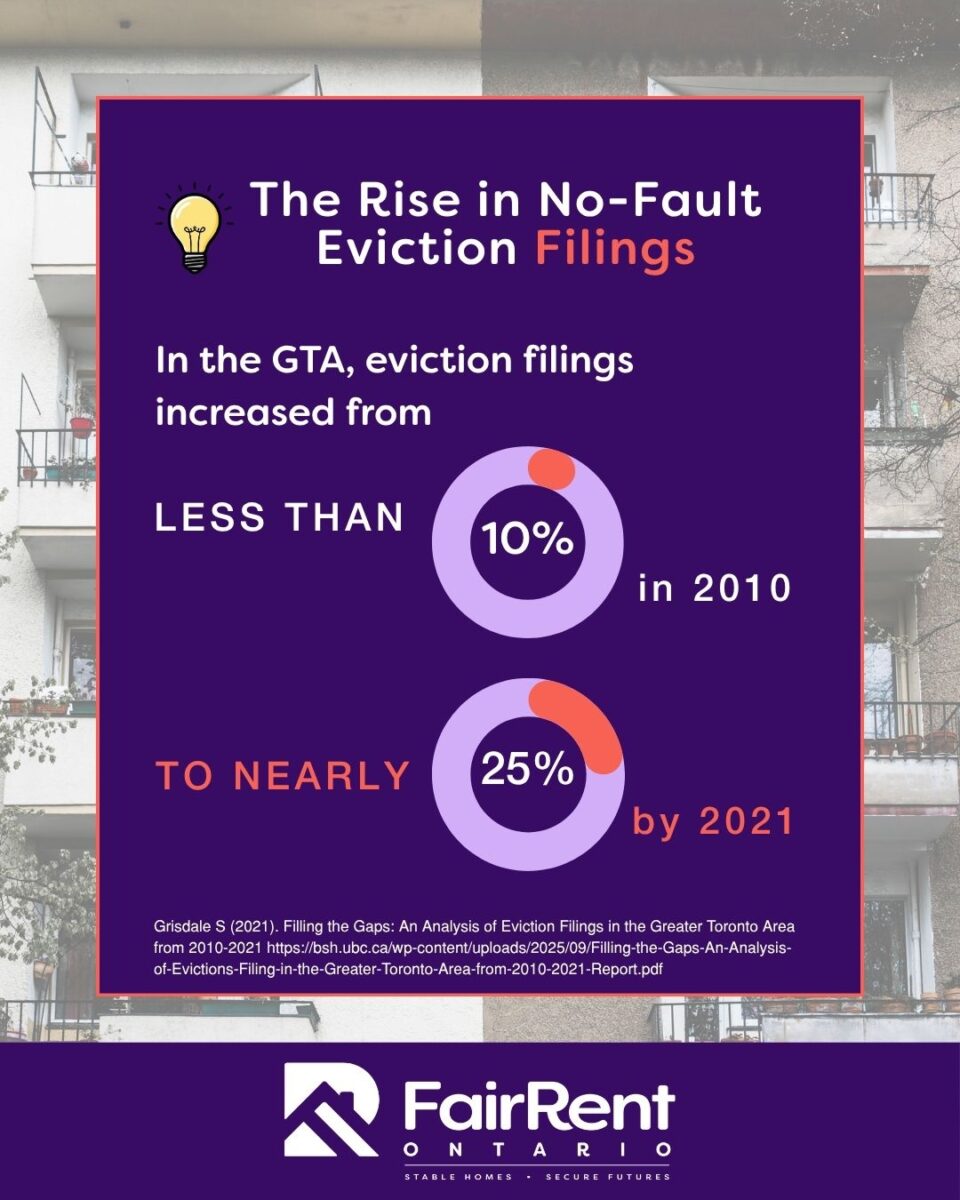
The rise in “no-fault” evictions (i.e. a landlord terminating a tenancy for reasons other than a breach of the Residential Tenancies Act) further illustrates this pattern. These include evictions for landlord’s own-use, property sale, or major renovations or demolitions, and while they appear legally neutral, they are frequently closely tied to profit-driven strategies. In the GTA, no-fault evictions increased dramatically from less than 10% of all filings in 2010 to nearly 25% by 2021. Between 2010 and 2019, Toronto experienced approximately 21,000 to 27,000 eviction filings annually, affecting roughly 4 to 5% of tenant households each year. For tenants, this means that increased rent prices translated directly into eviction notices, forcing them out of their homes and communities. Ultimately, the combination of financialization and vacancy decontrol has transformed housing into a system where displacement is not an unintended consequence, but a built-in feature of how profit is generated.
Who are the financialized landlords?
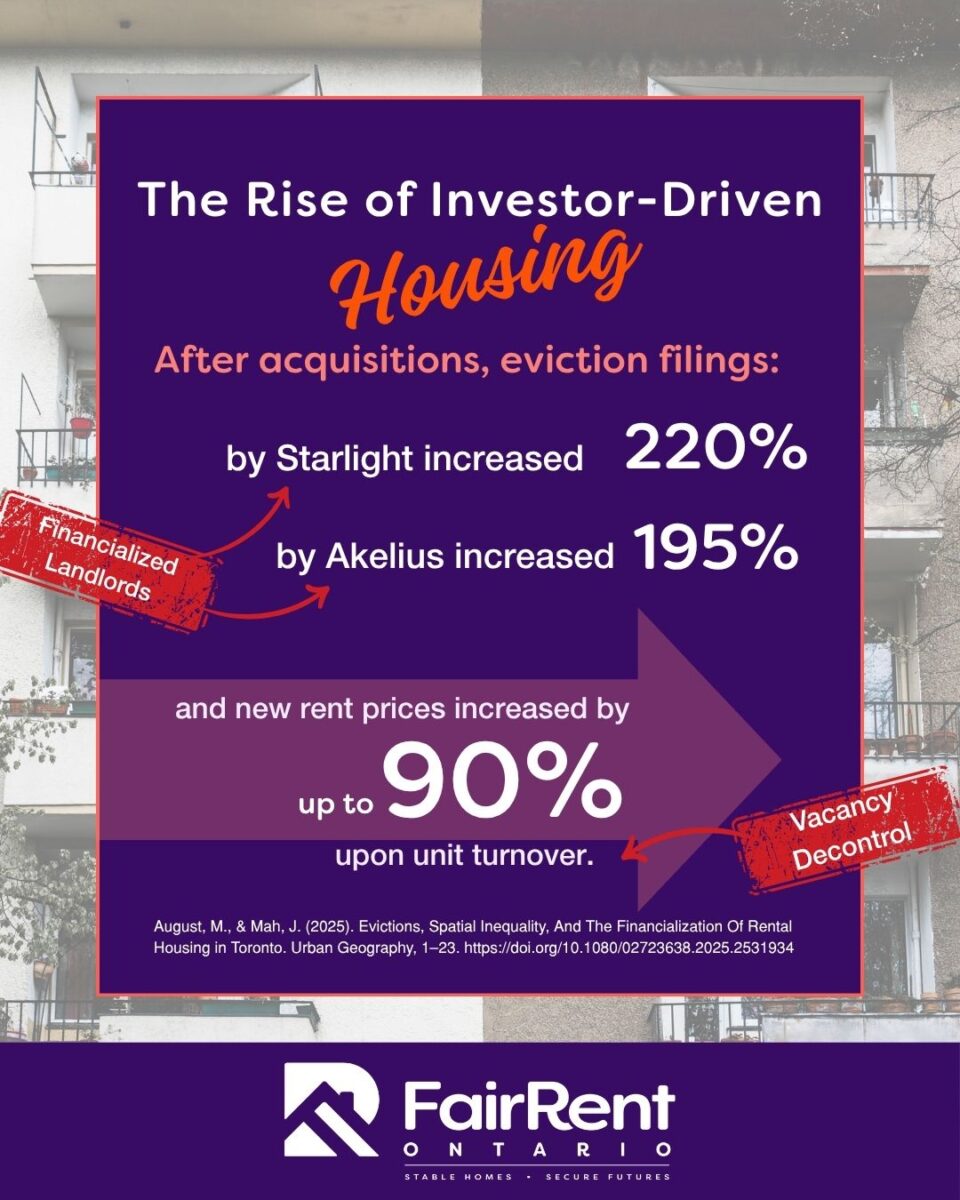
Institutional investors currently own an estimated 20 to 30% of Canada’s purpose-built rental housing and have become the largest acquirers of rental properties in Toronto over the past two decades. These financial actors, including financial firms like Starlight Investments, Akelius Residential Property, and CAPREIT, typically follow a profit-driven model that relies on increasing rents through tenant turnover. Empirical research shows that eviction filings increased by 220% after acquisitions by Starlight and by approximately 195% in the case of Akelius, alongside rent increases of up to 90% upon unit turnover. These financial firms consistently charge higher rents than other landlords and extract premiums above neighbourhood averages.
Additionally, financialized landlords often target “Neighbourhood Improvement Areas” (NIAs), which are identified as socially and economically vulnerable, and where eviction filing rates are highest. Studies further reflect that eviction activity is significantly higher in lower-income and racialized neighbourhoods, reflecting broader patterns of inequality in the GTA. This is partly driven by “rent gap” exploitation, where the difference between current and potential market rents is greatest, allowing landlords to maximize profits through turnover.
A research study from Toronto Metropolitan University found that tenants in Toronto’s Black-majority neighbourhoods were more likely to be impacted by “no-fault” evictions, where tenants are removed for reasons such as renovations, property sales, or landlord’s own- use. These tenants are forced to leave their homes, or face an onerous process to challenge their eviction at the Board. Consequently, displacement in the GTA is not random but rather concentrated in lower-income, disinvested inner-suburban areas, such as Scarborough, North York, and Etobicoke, where racialized and immigrant communities reside. This also reflects the broader patterns of the suburbanization of poverty and unequal eviction rates across the city.
Moreover, as of 2020, financialized companies controlled a significant share of seniors’ housing in Canada, owning roughly 33% overall, including 42% of retirement units and 22% of long-term care beds. Findings from this research showed that for-profit long-term care homes often deliver lower-quality care than public and non-profit facilities, with these outcomes linked to profit-driven models of operation.
In essence, the financialization of housing has become a common means for profit-driven displacement, and as a result, the tenants most affected are those already facing systemic barriers, reinforcing patterns of housing inequality across the GTA and other surrounding regions.
Conclusion: Why is this important, and what policies can protect tenants?
Evictions are profoundly destabilizing for tenants and communities. More importantly, it contributes to housing insecurity, loss of community ties, and the erosion of affordable housing. Financialization not only drives rent increases but also undermines long-term affordability across the housing market. When tenants are forced out, usually through no-fault evictions tied to renovation or sale, they are rarely able to find comparable housing within their original neighborhoods due to rapidly rising rents. This forces many to relocate farther from jobs, schools, and support networks, fundamentally uprooting their lives and contributing to growing spatial inequality across the region. Over time, these patterns erode long-standing communities and reduce access to affordable housing, as lower-cost units are systematically replaced with higher-rent ones.
Addressing the consequences of the ongoing financialization of housing, including the vacancy decontrol loophole requires structural policy change. Closing the vacancy decontrol loophole by extending rent control between tenancies would significantly reduce incentives for displacement and help stabilize rent prices over time. In addition, implementing rental renovation by-laws across multiple cities could help curb bad faith evictions by strengthening oversight and tenant protections, while still permitting legitimate renovation work to proceed where no tenant-related violations exist. Together, these policies act as measures to reduce landlord abuse, protect tenants from the harmful impacts of housing financialization, and support long-term housing affordability.
4 Ways You Can Take Action
1. Share this Blog and Image
Expose how vacancy decontrol gives financialized landlords an incentive to push out long-term tenants so they can charge new renters significantly higher rents.
2. Send a Letter to Your MPP
Demand your provincial leaders take action to end the 2018 Exemption and bring full rent control back to Ontario.
3. Become A Public Endorser
Become an endorser and publicly stand with your community to challenge the growing influence of financialized landlords.
4. Tell us how #FinancializedLandlords are impacting you and your rent
Tag us @FairRent_On on X, Facebook, and Instagram with your story.